
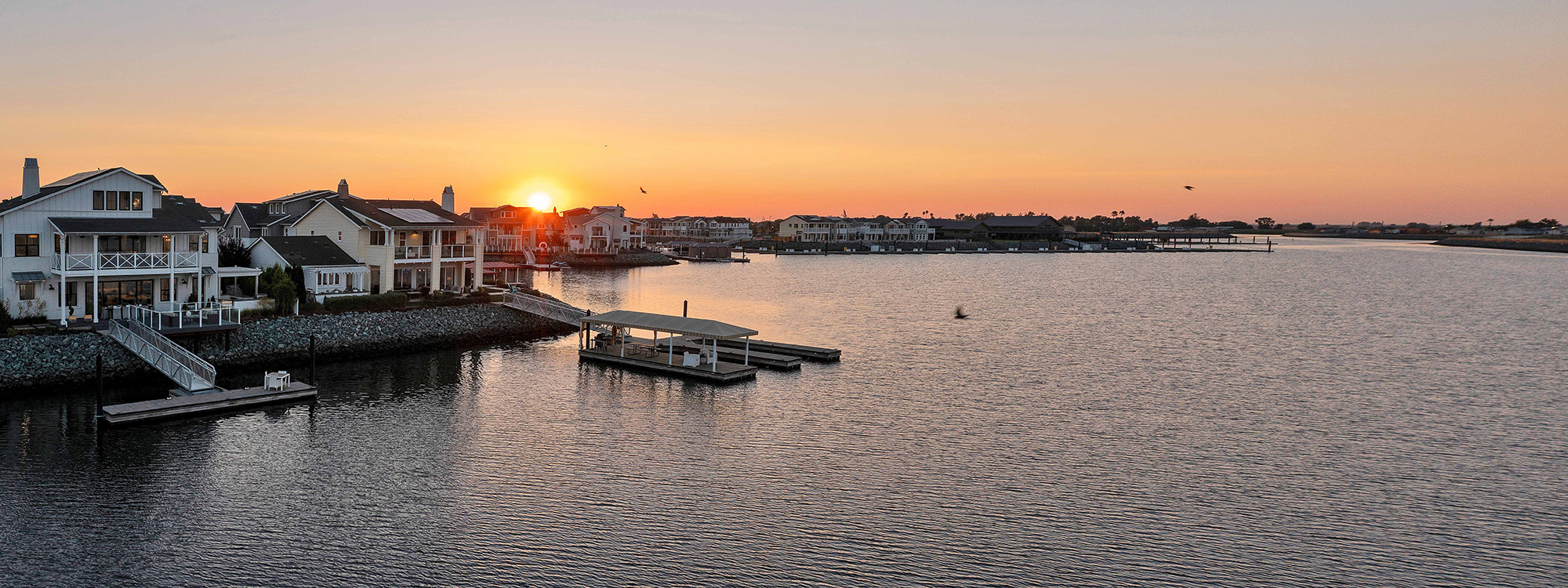
Homes in Delta Coves boast waterfront vistas and quick access to thousands of miles of Delta waterways through the lagoon. Just like any part of your home, the lagoon requires maintaining in order to keep it healthy and usable for the community.
Caring for the lagoon is a partnership between the California Division of Boating and Waterways (DBW), the developer and builders, board of directors, Community Life, and you — Delta Cove neighbors.
Throughout the year, the DBW monitors the Delta waters — including the Delta Coves lagoon — through aerial infrared imaging, underwater imaging, water quality testing, and weed pull tests to monitor growth of invasive plant species. With that data, they are able to create a care plan for the waterways and disseminate the information to the Delta Coves Board of Directors and Community Life.
Lagoon zones
The 2026 lagoon care plan
The DBW budget for herbicide treatments requires them to focus on high priority treatment zones in the Delta waters. Current invasive aquatic weed growth in Delta Coves’ lagoon does not meet the levels needed to qualify as high priority and the lagoon was not on the 2025/26 treatment plan.
At the direction of your board of directors in 2023, Community Life negotiated a donation to the state that covers the cost of herbicide treatments for the lagoon in 2024, 2025, and 2026. This treatment — which can only be performed by the DBW — will help with the time, cost, and work needed to keep the lagoon in shape during peak season for all residents.
Working together to care for the lagoon
CA Division of Boating and Waterways (DBW)
Treatments
Community Life & board of directors
Management
Homeowners
Lagoon zone
Developer
Unbuilt zones
Builders
Clean & clear
Lake Tech
Monitor
Frequently Asked Questions
Have a question about this year’s treatment plan? Read through the FAQ’s below and the lagoon care page. Reach out to Community Life with additional questions.
When will the DBW treat Delta Coves' lagoon in 2026?
The DBW anticipates treatment to take place in May - dependent on water levels, movement, and schedules. The treatment schedule will be shared through Delta Coves News emails.
What chemicals does DBW use to treat the lagoon?
Out of the hundreds of chemicals being used in agricultural and industrial settings, only 12 are approved to be used in the water and they must be administered by professionals.
The DBW will administer Diquat herbicide treatment for invasive aquatic plant species as needed. Treatments follow all local state, and federal regulations for herbicide use. Monitoring takes place to ensure the health of the Delta waters.
Diquat is approved by the US Environmental Protection Agency (USEPA) and the California Department of Pesticide Regulation (DPR). The product is also allowed under the Biological Opinions that the program has from the US Fish and Wildlife Service (USFWS) and the National Marine fisheries Service (NMFS). Finally, the product is allowed for use in aquatic sites by the State Water Resources Control Board (SWRCB) and their National Pollutant Discharge Elimination System (NPDES) permit.
Where do invasive species come from?
Poor boating habits, private aquariums, and shipping containers releasing ballasts bring invasive species into the Delta waters.
Where can I find information on harmful algae blooms?
Algae occurs naturally within the Delta waters. The State of California Water Quality Monitoring Council provides details on recognize algae and how to report suspected harmful algal blooms (HABs).
Does the DBW treat just outside the lagoon's breach?
DBW does not treat outside the lagoon under the agreement with DCMC. The state may independently decide to treat that section of the Delta waters should the waterway require treatment and the state have resources to do so.
Does the DBW also work to eradicate invasive mussels?
While they do assist the California Department of Fish & Wildlife, the CDFW manages the mussel prevention programs in the Delta.
Is the DBW concerned about water levels, drought, and diverting water to southern California?
Of course water levels are a concern. During the 2019 drought, the state developed a special grant to help with the additional submersed aquatic vegetation that grew due to lower water levels.
Where can I access the water quality monitoring dashboard?
Residents can access the Delta Coves water monitoring station from the lagoon hub.
Did Lake Tech's water quality monitoring see any negative effects to the lagoon after the 2024 herbicide treatment?
The data did not show any direct negative impact post herbicide treatment.
Is Delta Coves' water considered brackish.
Brackish water typically contains between 0.05 and 30 grams of salt per liter. At 0.01 grams of salt per liter of water, Delta Coves water is on the lower end of the spectrum.
What is the benefit of a water circulator at my dock?
Water circulators help keep water from becoming stagnant and provide a less nurturing environment for subaquatic vegetation and algae. Learn more about caring for your lagoon zone.
What are the most commonly occurring plant species to watch out for in the lagoon?
The DBW looks at both floating and submersed aquatic vegetation. In the Delta Coves lagoon, the primary species identified are Brazilian Waterweed (egeria densa) and Coontail (certeophyllum demersum).
Why do we have to treat for these plants?
These submersed aquatic vegetation create mats that impede navigation of the waterways. They also affect the health of the Delta ecosystem.
Invasive plants take over for native plants that provide food and shelter for animals that call the Delta their home.
Can I just cut the plants?
No, much like land weeds, they have to be removed at the root.
Even pulling them out, they can repropagate easily or drop seed that grow into new plants.
Can I use herbicides in my lagoon zone or riprap?
Do not use herbicide treatments in the lagoon or on rocks where they tide can reach them. Offenders face fines up to $30,000 and potential jail time.
If you must use an herbicide treatment on your riprap, it should be something approved for aquatic use and not applied anywhere the tide reaches – dry rocks only.
Will treatments show on the DBW schedule even if they're handled by a contractor?
Yes. Delta Coves lagoon is Site 171. Sign up for emails through the DBW to receive updates. In addition, your Community Life team will include the treatment date in a Delta Coves News email.
How long after treatment should we wait to use the lagoon?
Before treatment occurs, the DBW team onsite requests anyone in or on the water or surrounding docks to exit the area. Residents and their guests can resume normal water activities in the lagoon or on docks two hours after treatment is complete.
What happens to the plants once they're treated?
The targeted submersed vegetation will be killed off, then disintegrate and join the silt at the bottom of the lagoon or get carried away by the tides.
How does Lake Tech fit into the treatment plan?
Lake Tech provides water quality data through sensors located on the yellow buoys in the lagoon. This data collects on a website, where the board of directors and homeowners can access information in real time.